Milkweed, rattlepods and the winged wanderers of Mistletoe Homestay, Munnar
A nature story from Mistletoe Homestay & Art Gallery • Munnar, Kerala
Some guests arrive at Mistletoe with suitcases. Others arrive with wings. The second kind never calls ahead, never asks for the Wi-Fi password and certainly never worries about checkout time. They simply appear — sometimes in brilliant orange, sometimes in delicate blue, sometimes as pale yellow flashes drifting through the greenery.
At Mistletoe Homestay & Art Gallery in Munnar, we have come to believe that a garden should be more than a collection of beautiful plants. It should be a place where life finds a reason to stay, even if only for a little while. That belief has shaped our planting of milkweed, rattlepods, Indian Cress and Showy Asian Grapes, alongside many other flowering plants.
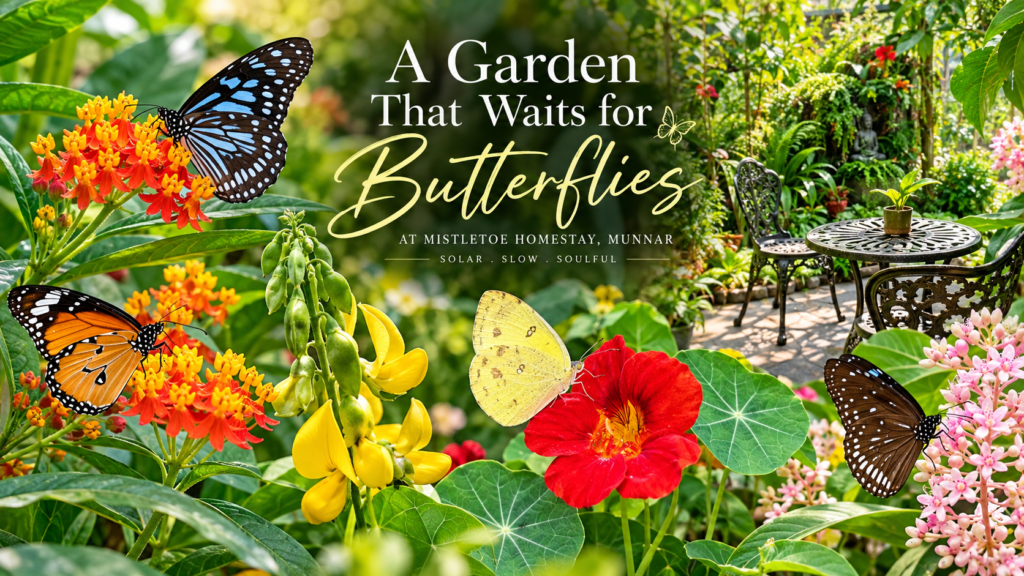
Among the greenery are clusters of tiny orange and yellow flowers belonging to tropical milkweed (Asclepias curassavica). They look like cheerful little ornaments, but for certain butterflies, milkweed and related plants can be nurseries. In one of our nature expoloration trips to the highlands of Vattavada, I found the milkweed flowers with hundreds of butterflies and out of curiosity and got a few saplings and planted in our garden. It took more than a year and care for it adopt to the low land environment and now we have them, flowering and attracting butterflies.
Plain Tigers and Striped Tigers belong to a group of butterflies whose caterpillars use particular milkweed-family plants. A female searches for a suitable leaf, lays an egg, and begins a remarkable transformation. The caterpillar feeds and grows, forms a chrysalis, and eventually emerges as a butterfly.
Milkweed contains compounds called cardenolides. Some specialist caterpillars tolerate and retain these chemicals, helping make themselves less appealing to predators. Suddenly, a leaf with a few bites looks rather exciting: it may mean that someone has made a home there.
Rattlepods: a butterfly’s secret pharmacy
Yellow rattlepod (Crotalaria sp.) flowers and developing seedpods in our garden.
Nearby, yellow pea-like flowers and hanging green pods belong to a rattlepod (Crotalaria). The name comes from the sound made by seeds inside mature dry pods. But for some tiger and crow butterflies, these plants can offer something much more intriguing than nectar.
Certain Crotalaria species contain pyrrolizidine alkaloids. Adult butterflies, especially males of some species, seek out these compounds, which can contribute to chemical defence and the production of courtship substances. A butterfly visiting a rattlepod may be collecting ingredients for both protection and romance. Nature invented its own pharmacy long before we did.
The winged wanderers of the Western Ghats
The Plain Tiger (Danaus chrysippus), orange with black-and-white markings, and the beautifully veined Striped Tiger (Danaus genutia) are closely associated with suitable milkweed-family host plants. The Blue Tiger (Tirumala limniace), with bluish-white markings on dark wings, is known for seasonal movements in southern India.
Common Crows (Euploea core) glide with an unhurried elegance, while Double-branded Crows (Euploea sylvester) are another fascinating member of this butterfly group. These species may use alkaloid-bearing plants, including certain rattlepods. They are examples of butterflies associated with our chosen plants, not a list of sightings that we have formally verified at Mistletoe.
The Western Ghats are part of a larger landscape through which butterflies move as seasons, rain and vegetation change. A small garden cannot create a migration corridor by itself, but a thoughtful patchwork of nectar plants, suitable larval hosts and shelter can offer useful resources within that wider landscape.
Indian Cress: the red flowers and a pale-yellow visitor
One of the brightest corners of our garden belongs to Indian Cress, better known as Nasturtium (Tropaeolum majus). Its scarlet flowers glow against rounded, umbrella-like green leaves. We planted it for its cheerful colour and its appeal to visiting pollinators. Then came a lovely surprise.
We began noticing relatively large, pale lemon-yellow butterflies visiting these red flowers. Their wings seemed creamy, with delicate brownish markings. They may be Mottled Emigrants (Catopsilia pyranthe), although a clear photograph is still needed for a confident identification.
Mottled Emigrants are found in India. Their caterpillars generally use Senna and related plants, while adults visit flowers for nectar. This teaches us an important distinction: a butterfly may drink nectar from one plant but require an entirely different plant for its caterpillars. A thriving garden needs both dining rooms and nurseries.
Showy Asian Grapes: beauty in the understory
Pink flower clusters of the plant locally referred to as Showy Asian Grapes
Another lovely presence is our pink-flowering plant, likely a Medinilla species, often called Showy Asian Grapes. Its hanging clusters and strongly veined leaves lend the garden a gentler colour. It is not a documented principal larval host for the tiger butterflies described here, but it contributes to the garden’s layered vegetation and floral variety. We believe different shapes, heights, flowers and sheltered corners are worth making room for.
A little wilderness is a beautiful thing
There is a temptation to make a garden perfect: every hedge trimmed, every leaf spotless, every fallen flower swept away. But a caterpillar needs leaves to eat, a butterfly needs somewhere to rest, and insects need shelter. We have learned to appreciate a little disorder. A chewed leaf can be a sign of life.
We avoid unnecessary pesticides and continue learning which plants are most appropriate for the local ecosystem. Tropical milkweed and some ornamental species are non-native, so thoughtful management and a preference for locally suitable native host plants matter. The goal is not simply to attract butterflies for photographs. It is to care for a healthier little habitat.
A real corner of Mistletoe — our cast-iron table and chairs among the greenery.
There is a small courtyard at Mistletoe with an old-fashioned cast-iron table and chairs. Sit here with tea, listen to the birds and watch sunlight filtering through the leaves. Perhaps a butterfly will arrive. Perhaps a caterpillar will reveal itself beneath a leaf. Or perhaps nothing dramatic will happen at all.
That is perfectly fine. Slow travel is not simply about visiting beautiful places; it is about allowing yourself time to notice their everyday rhythms. The most memorable travel experiences are not always printed on an itinerary. Sometimes they happen unexpectedly, when a pale-yellow butterfly settles on a bright red flower.
We planted a garden for butterflies. Somewhere along the way, they taught us how to slow down.
Come to Mistletoe for the mountains. Stay a little longer for the little wonders that is endeangered .