Neelakurinji and the extraordinary clock hidden in the mountains of Munnar
By Joe Joseph
Some flowers announce a season. Neelakurinji announces the passage of time.
Twelve monsoons must pass. Twelve summers must fade. Then, one season, the mountains of Munnar turn “mouve blue”.
High in the Western Ghats around Munnar grows an otherwise modest shrub called Strobilanthes kunthiana. For years it remains part of the mountain vegetation, easily overlooked by an unfamiliar eye. Then comes an extraordinary moment. Across suitable high-altitude grasslands, countless plants flower almost simultaneously, washing the slopes in shades of blue, violet and purple.
Then they disappear. And the mountains begin another wait of approximately twelve years.
It is this unusual rhythm that has made Neelakurinji one of the most celebrated wildflowers of India.
An this is how google defines this unique colour of Kurinji flower – Mauve blue is a muted, sophisticated blend of cool blue and soft mauve/purple that typically translates into a dusty periwinkle, slate-lavender, or cool-toned violet. It leans heavily toward a tranquil, low-to-medium saturation tone, balancing the romantic nostalgia of classic mauve (#E0B0FF) with the crisp, calm properties of a blue undertone.
A Memory From 2006
My own relationship with Kurinji goes back particularly to 2006.
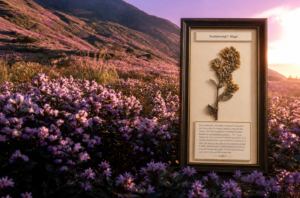
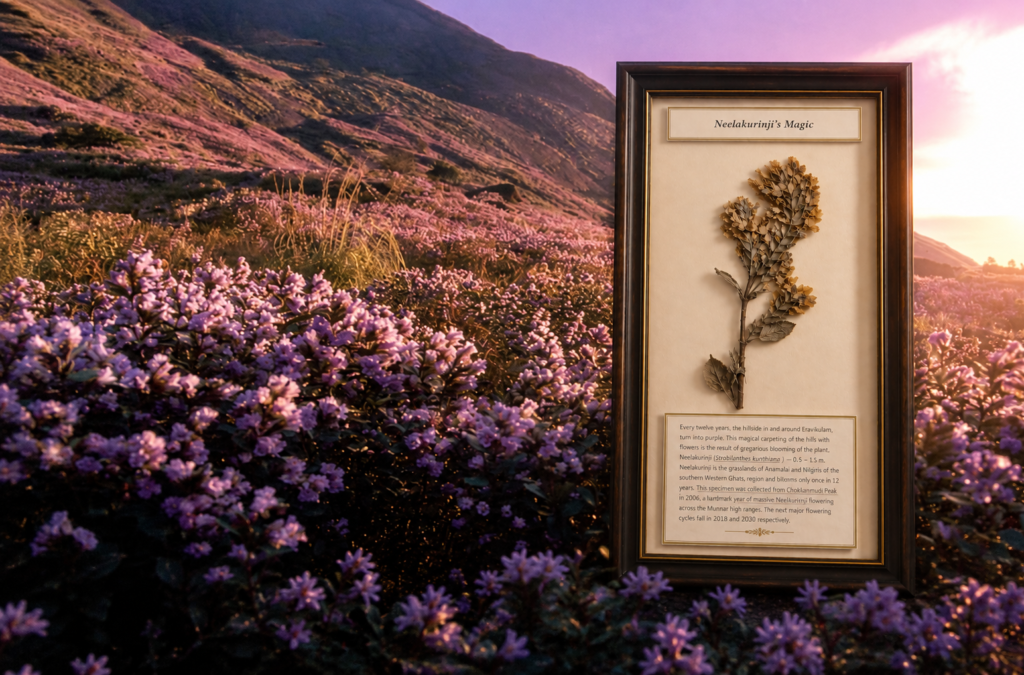
During the great flowering that year, I was trekking on Chokkanmudi, one of the magnificent peaks of the Munnar landscape. Surrounded by flowering Kurinji, I collected a small flowering branch as a memory of the experience.
At that time, I did not know whether any restrictions concerning the collection of Kurinji existed in that particular location. Today, with a much greater awareness of the fragility of mountain ecosystems, I would certainly encourage every visitor to leave wildflowers exactly where they grow.
But that small branch survived. I dried and preserved it and eventually had it framed. Nearly two decades later, it remains with me—a fragile botanical memory of a mountain landscape during one of its most remarkable seasons.
I have not had the specimen scientifically authenticated, so I do not claim that it is definitely Strobilanthes kunthiana. What I know is its story: it was collected from Chokkanmudi during the great Kurinji flowering of 2006.
Looking at it today raises an interesting thought. We often preserve photographs of landscapes. Occasionally, almost accidentally, we preserve a tiny fragment of their history.
The Flower That Counts to Twelve
Neelakurinji belongs to the genus Strobilanthes in the family Acanthaceae. The Western Ghats contain remarkable diversity within this group, but Strobilanthes kunthiana has captured the public imagination because of its synchronized mass flowering.
A generation grows for years before flowering. After flowering and producing seed, the mother plants die. The seeds establish another generation and the cycle begins again.
Mass flowering has historically been recorded at roughly twelve-year intervals, including 1994, 2006 and 2018.
Human beings measure twelve years through birthdays, school years, careers, marriages and changing generations. The Kurinji measures them silently. Perhaps this explains some of our fascination with it. A person fortunate enough to witness four great flowerings has already watched nearly half a century pass.
There Is More Than One Kurinji
The popular imagination often treats Kurinji as a single flower. Botanically, the story is considerably richer.
The Kurinji Field Guide – Eravikulam National Park, prepared by Pradeep A.K. for the Anamudi Forest Development Agency, Wildlife Division, Munnar, documented 20 Strobilanthes species in the Munnar landscape:
Strobilanthes anamallaica, S. andersonii, S. barbatus, S. decurrens, S. foliosus, S. gracilis, S. heyneanus, S. homotropus, S. kunthianus (now generally treated as S. kunthiana), S. lawsoni, S. luridus, S. micranthes, S. microstachya, S. neoasper, S. pulneyensis, S. rubicundus, S. sexennis, S. tristis, S. urceolaris and S. zenkerianus.
They occupy different niches of the Western Ghats—high grasslands, shola margins, moist forests and mountain slopes—and they do not all share the famous twelve-year flowering rhythm. This diversity makes Kurinji not merely a tourist attraction but an entry point into understanding the extraordinary botanical richness of the Western Ghats.
Eravikulam and a Fragile Mountain World
Eravikulam National Park has become synonymous with the great Neelakurinji flowering. Its high-altitude grassland-shola ecosystem is also famous as an important habitat of the Nilgiri Tahr.
But the beauty of these mountains hides their vulnerability. A mass flowering attracts enormous human interest. Roads become busy, viewpoints fill with visitors, and thousands arrive hoping for the photograph of a lifetime.
The challenge is to ensure that our admiration does not become another pressure on the very landscape we have come to admire.
We know more about conservation today than many of us did twenty years ago. Wildflowers should remain on the mountain. Visitors should stay on permitted trails, avoid trampling vegetation, carry waste back and respect restrictions imposed by forest authorities.
Take the photograph. Keep the memory. Leave the flower.
My own little specimen from 2006 has, ironically, become a reminder of precisely that lesson.
Munnar Beyond the Blue Flower
There is another danger in the enormous popularity of Neelakurinji: seeing Munnar only through the spectacle of a twelve-year flowering.
The real wonder is the ecosystem that makes such a phenomenon possible. The folds of dark shola forest among rolling grasslands, monsoon clouds travelling across ridges, endemic birds, orchids, balsams, butterflies and countless less-famous plants are all pieces of the same landscape.
Neelakurinji is perhaps its greatest performer. But the mountain itself is the theatre.
If travellers begin to understand the ecology behind the photograph, tourism can become an ally of conservation rather than merely a consumer of scenery.
When Will the Mountains Turn Blue Again?
In 2018 Kurinji had kept its twelve-year appointment. The flowers were ready.The mountains were preparing to turn blue.
But for Kerala… 2018 became a year of pain.
Unprecedented rains brought devastating floods and landslides;Homes were lost.,Roads disappeared;Mountains slipped;Communities suffered. And at the very moment when thousands of us were waiting to celebrate one of nature’s most beautiful spectacles…nature reminded us of something far more powerful.
We are not merely spectators of these mountains.
We are part of their fragile ecology.
For many of us, the great Kurinji season of 2018 became overshadowed by the floods. The flowers had arrived…but celebration had to wait.
Perhaps we can allow ourselves a poetic thought. Was nature asking us to look beyond the flower?
Was she reminding us that admiring a mountain is not enough…
we must also learn to protect it?
Not as punishment. Not as prophecy. But as a lesson we humans might choose to carry forward.
Because a landscape cannot be loved only when it flowers. It must be loved when it rains.When its forests need protection.
When its streams need cleaning. When its slopes need care. And when nobody is watching.
The last celebrated mass flowering occurred in 2018. Nature, however, is not a railway timetable, and flowering can vary locally according to populations and environmental conditions.
Whenever another great flowering arrives, thousands will once again travel towards Munnar. Some will photograph it. Some will simply stand and stare. Children who saw the previous flowering will return as adults. Adults will return with children of their own.
And somewhere among those blue-purple slopes, another generation of Kurinji will complete a biological journey that began years before the visitors arrived.
That may be the most beautiful thing about Neelakurinji. It reminds us that the mountains operate on a scale of time larger than our holidays, our photographs and sometimes even our memories.
We do not summon the Kurinji. We wait for it. And when the mountains finally turn blue, perhaps the greatest privilege is simply to be there—and to leave them exactly as we found them.
Joe Joseph is a hospitality entrepreneur and nature enthusiast based in Munnar.