The human mind demands a binary script. To make sense of the wild spaces we visit, we neatly divide their inhabitants into a grand theatrical cast: the “iconic heroes” whose majestic figures anchor our tourist postcards, and the “notorious villains” whose names headline our emergency news feeds.
But out here on the steep, mist-choked plantation tracks of Idukki, where the dense Shola forest maps blur seamlessly into human tea gardens, those convenient boundaries dissolve into a heartbreaking, raw reality.
As documented in an extensive, sobering investigative feature by the Malayala Manorama newspaper, the human toll across this mountainous landscape has surpassed a mere conservation crisis—it is an open, bleeding wound. Over the past few decades, more than 300 human lives have been violently claimed by human-elephant encounters in this single district alone. This is not a chronicle of malicious, rogue monsters, nor is it a simple record of human encroachment. It is the story of two deeply intelligent, emotionally complex, and land-dependent mammalian species forced into a lethal game of musical chairs within a shrinking, fragmented mountain ecosystem.
The Heroes and Villains of the Sholas
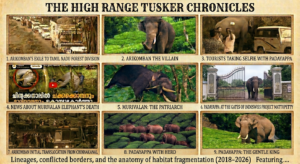
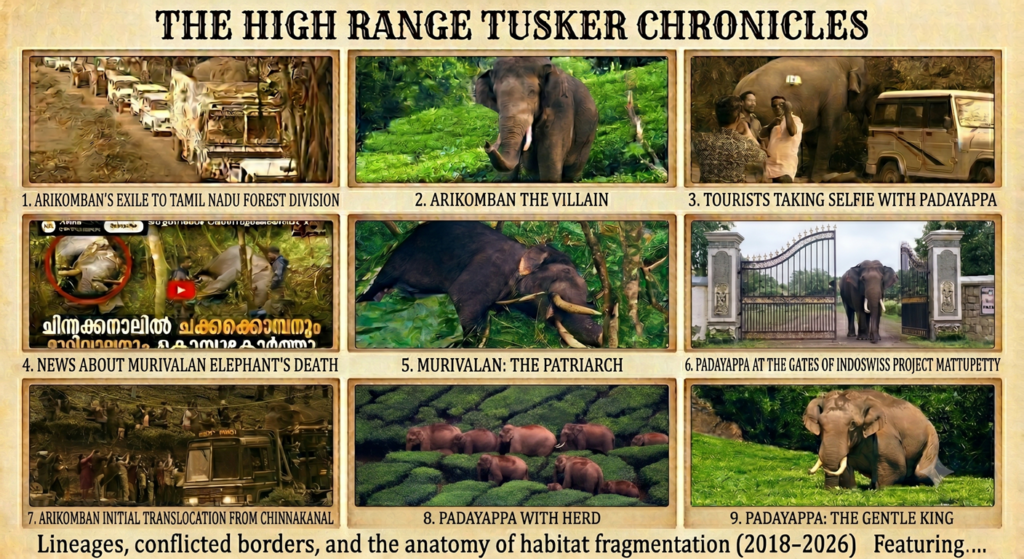
1. Padayappa: The Gentle Monarch — To the residents of Munnar town and the surrounding valleys, Padayappa is the definitive “hero.” Named after the indomitable, larger-than-life silver screen character due to his staggering physical stature and magnificent, asymmetric tusks that almost scrape the mountain earth, this fifty-year-old bull is treated with an affectionate, protective familiarity.
Padayappa subverts the typical “wild beast” archetype. He casually navigates the Munnar-Top Station highway, raiding roadside fruit vendors with a calm, almost courteous precision. He does not flee from human shouting, nor does he charge in unprovoked panic; he has decoded the human infrastructure of the tea estates better than most regional town planners. Yet, his heroic status remains desperately fragile. He is an aging king operating under immense biological stress, forced to navigate ancient migratory paths that are now obstructed by luxury tents, parking lots, and selfie-seeking crowds.
2. Arikomban: The Sovereign of the Swamps — If Padayappa is the beloved hero, Arikomban was cast as the ultimate, unredeemable villain of the High Ranges. His name is a literal description of the behavioral adaptation that doomed him: Ari (Rice) and Komban (Tusked One).
Arikomban did not raid concrete kitchens or tear down ration shops out of malice; he targeted them because human habitations were built directly over the high-calorie, swampy grasslands (vayals) where his maternal herd had fed for generations. He became a tactical mastermind, peeling off corrugated tin roofs with surgical precision to extract bags of grain. Blamed for multiple human fatalities and systemic structural destruction, his presence ignited massive civil protests. In April 2023, following a massive state operation, he was tranquilized, radio-collared, and exiled to the Periyar wilderness, and subsequently pushed across the border into Tamil Nadu. But his exile solved nothing. It merely highlighted a haunting truth to the conscious traveler: we did not fix the systemic landscape breakdown; we simply deported the refugee.
3. Chakkakomban: The Lone Guardian — Operating for years within the shadow of Arikomban’s notoriety was Chakkakomban, named for his precise seasonal obsession with Chakka (Jackfruit).
Less outwardly aggressive than Arikomban but remarkably persistent, this massive bull tracks the exact ripening dates of backyard jackfruit trees across Idukki’s homesteads with calendar-like accuracy. Following the exile and death of his contemporary bulls, Chakkakomban has been left as the lone mature breeding bull holding the genetic lineage of the fragmented Chinnakkanal herd. He carries the weight of an entire local population’s survival on his battle-scarred shoulders.
The Ghosts of Chinnakkanal: The Fallen Lineages
The true depth of the Chinnakkanal tragedy remains incomplete if we only speak of the living. The dense hill tracks hold the ghosts of legendary bulls whose quiet passings reveal the invisible, lethal grid we have laid across their ancient homes.
| • Arikomban — Exiled by Forest Department (April 2023) |
| • Soochikomban — Electrocuted by Encroachment Fencing (Late 2023) |
| • Murivalan — Perished from Turf War Injuries (Post-Arikomban Collapse) |
| • Chakkakomban — Left as the Lone Bull holding the Breeding Line (2026) |
4. Soochikomban: The Needle-Tusked Tragedy — Named for his uniquely thin, razor-sharp, upward-pointing tusks (Soochi meaning Needle), this majestic bull was a master of camouflage. He could move his massive frame through the steep gradients of the Anayirangal dam catchment area completely undetected by the Forest Department’s drone surveillance teams.
His story provides the definitive link between human infrastructure and wildlife mortality. In late 2023, while foraging along a traditional path that had been carved up by a private plantation lease, Soochikomban touched a sagging, poorly maintained, high-voltage electric fence wire. He was electrocuted instantly—a silent casualty of the invisible landmines humans place across ancestral wildlife corridors.
5. Murivalan: The Veteran of the Turf Wars — Named for his severed tail—lost during a brutal territorial combat in his youth—Murivalan was the grizzled, resilient patriarch of the Santhanpara landscape. His end illustrates the grim biological consequence of habitat isolation.
When Arikomban was forcefully removed from the valley ecosystem in 2023, the historical territorial hierarchy collapsed. Murivalan was forced into a desperate, violent confrontation for breeding dominance with Chakkakomban. Suffering deep, internal puncture wounds from the encounter, the aging warrior eventually succumbed to his injuries in the wilderness—a stark reminder that when humans artificially compress animal habitats, we drive them to destroy their own kind.
6. Hosur: The Boundary Crosser — Frequently recorded in historical field-monitoring logs, Hosur belonged to a distinct group known colloquially in the High Ranges as the ‘dwarf elephants.’ Short-statured, incredibly compact, and notoriously aggressive, Hosur and his companion bulls migrated over the political borders from Tamil Nadu.
Hosur represents a crucial ecological reality for the eco-conscious nomad: wildlife refuses to recognize political borders. His entry into the Idukki ledger proved that the degradation of forest connectivity in neighboring states directly compounds the biological pressure and explosive conflict density within Munnar’s remaining Shola belts.
The Anatomy of an Open Wound: The Tragedy at Transfer Curve
The cinematic romance of these elephant legends completely evaporates when you look at the raw, agonizing human cost. The專Malayala Manorama investigative feature reminds us that these casualties are not abstract numbers on a government spreadsheet; they are families violently shattered in a matter of seconds.
On the rain-blinded morning of June 8, 2026, the fragile peace of the mountains was shattered by an unforgettable tragedy. At a sharp bend known as the Transfer Curve near Singukandam in Chinnakkanal, Mari, a 36-year-old single mother and daily wage laborer, was walking her 11-year-old son, Dakshan, and her young daughter through the heavy fog to catch their morning school bus.
It was exactly 8:00 AM. The valley was blanketed in the thick, deafening monsoon downpour that compromises both sight and sound in June. Because of the near-zero visibility conditions, neither the mother nor the children realized they had stepped directly into the path of a wild female elephant and her two-year-old calf standing silently on the roadside tarmac. Sensing an immediate, existential threat to her vulnerable calf, the protective mother elephant struck instantly.
Mari did not run. In her final, instinctive act on earth, she threw her body over her children, shielding them from the impact. She was trampled to death on the spot. Her 11-year-old son sustained devastating, life-threatening internal injuries and was rushed to the Kottayam Government Medical College, while her daughter narrowly escaped physical harm. Mari was the sole provider for her two school-going children, raising them single-handedly after her husband’s death two years prior. Her sudden death ignited a wave of fierce, grief-stricken protests across Chinnakkanal. Angry residents blocked the state highways, refusing to allow authorities to move her body until the government committed to clear, structural solutions and guaranteed the lifetime welfare and education of her newly orphaned children.
The Thin Green Line: The RRT and Tactical Containment
When these flashpoints erupt, the thankless responsibility of standing directly between a grieving, furious populace and an equally panicked elephant herd falls upon the Kerala Forest Department’s elite Rapid Response Teams (RRT).
The RRT units are specialized, highly trained tactical units operating on the absolute frontlines of wildlife management. Armed with thermal imaging drones, heavy-duty searchlights, and multi-frequency acoustic sirens, these officers live on the ground 24/7. The moment an alert is triggered, they deploy as a human shield—managing panicked crowds with one hand while attempting to steer multi-ton, highly stressed animals back into forest boundaries with the other.
To modernise this desperate defense, the department has deployed an array of technological interventions:
• AI-Enabled Smart Cameras: Advanced surveillance grids have been erected along critical crossing corridors. These smart sensors identify elephant silhouettes even in zero-visibility Shola fog, automatically pushing immediate SMS alerts and localized voice notes to thousands of plantation workers and estate supervisors within the specific geographic grid.
• Acoustic Siren Vehicles: Specially modified tactical vehicles patrol vulnerable estate paths during peak commuting hours (4:00 AM to 8:00 AM and late evenings) using non-injurious acoustic frequencies to clear migratory paths before laborers step into the fields.
Yet, as the Manorama feature unflinchingly observes, the RRT is fighting a structurally impossible battle. The department can drive an elephant out of a village clearing, but they cannot create a forest for them to stay in. If an ancient migratory route is permanently blocked by a newly built multi-story resort, an electric fence, or a network of commercial properties, the animal will inevitably circle back through a human settlement within hours. The RRT can manage the immediate panic, but they cannot repair a broken map.
The Witness: A Personal Prick of Conscience
I have spent more than half a century living along these rugged valley villages. My earliest memories are not of tourist off-roaders or multi-story concrete hotels, but of the deep, echoing night calls of maternal elephant herds moving unhindered through the Shola valleys. For fifty years, I have listened to the oral histories of the Muthuvan elders, watched the seasonal migration of the mountain streams, and quietly witnessed the systematic dismantling of the land that shaped me.
Today, like many who watched our traditional agrarian economy shift under the weight of modernization, I make my living out of the tourism boom. I guide travelers, design itineraries, and show urban nomads the panoramic beauty of the High Ranges.
But every single journey I lead comes with a sharp, persistent prick of conscience.
I find myself trapped in a profound ethical paradox. The very industry that sustains my family is the engine accelerating the fragmentation of the hills I call home. Every new track carved through a fragile gradient to give tourists an “unobstructed sunrise view” cuts an ancient migratory pathway. Every concrete pillar driven into a valley wetland acts as a structural barrier forcing an elephant like Chakkakomban closer to a human kitchen.
What we are building in Munnar right now is the exact opposite of Satoyama—the traditional philosophy of landscape literacy that I have come to deeply respect. Satoyama advocates for a managed, harmonious transition zone where human communities and deep wild ecosystems mirror and support one another, dynamically coexisting without crossing lethal boundaries.
Instead, our modern, unmindful architecture builds an uncompromising fortress directly over their ancestral living rooms. We invite people here to experience nature, but our lifestyle ensures that the very nature they came to see is cornered, exiled, or killed.
When I look out over the concrete-heavy ridges of Chinnakkanal, I realize that real ecological degradation isn’t just an abstract headline in the morning paper. It is a daily, lived grief. We must find a way to reconcile the economics of modern survival with a deep, unyielding respect for the wilderness, or we will be left guiding travelers through a beautiful, silent graveyard.
The Naturalist’s Verdict: A Destiny Written in Concrete
For the conscious traveler, the tragedy of the Chinnakkanal corridor forces a profound re-evaluation of responsibility. The true “villain” of this landscape is neither the protective mother elephant at the Transfer Curve, nor was it the exiled Arikomban.
The crisis in Idukki is a crisis of spatial planning. The core elephant habitats of Chinnakkanal and the Anayirangal basin—wetlands and valleys explicitly designed by nature to hold water and sustain megafauna—were systematically deforested, leased out, and covered in concrete over the past fifty years to feed a short-sighted, unregulated tourism boom.
When we build luxury resorts, school bus stops, and commercial townships directly inside the living rooms of these animals, we engineer a destiny of violent friction. The elephants are not invading our space; they are simply tracing a map etched into their genetic memory over millennia. Until our travel choices and regional development frameworks respect the strict, physical boundaries of these ancient corridors, the mist of Munnar will remain stained with the quiet horror of an unnecessary war.