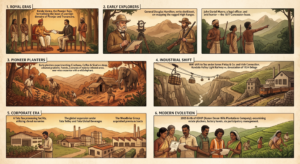
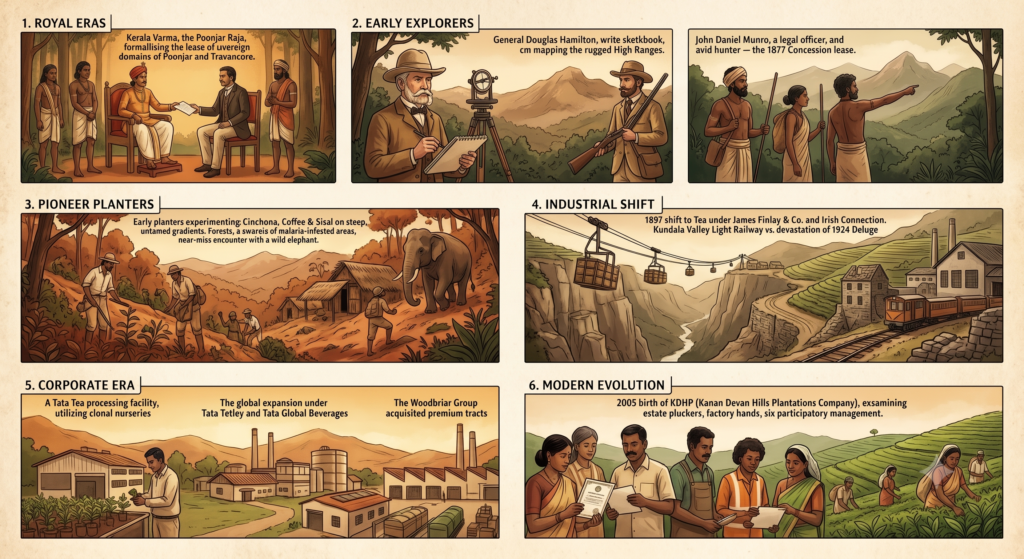
The landscape of Munnar appears as a seamless tapestry of sculpted green hills. However, this uniformity is entirely a product of modern industrial history. The transition of the High Ranges from an untamed, sovereign forest ecosystem into one of the largest tea-plantation networks in the world is a multi-layered chronicle spanning royal decrees, colonial hunting expeditions, global corporate consolidations, and a pioneering shift toward employee-owned management. This historical survey outlines the chronological lineage of the Kanan Devan Hills.
The Royal Eras: Poonjar and Travancore Decrees
For centuries, the land that constitutes the High Ranges was under the sovereign jurisdiction of the Poonjar Royal Dynasty. The Poonjar Rajas, who traced their ancestry to the Pandya kings of Madurai, held vast, unmapped forest tracts stretching across the Western Ghats. These mountains served as hunting grounds and sources of wild forest produce, managed loosely in cooperation with the indigenous tribes.
By the 19th century, the geopolitical dynamics of Southern India shifted. The Kingdom of Travancore, through territorial expansion and strategic treaties, established suzerainty over the Poonjar territories. While the Poonjar dynasty retained immediate landlord (Jenmi) rights over the hills, any external commercial exploitation required the administrative approval of the Travancore Royal Court and the British Resident advisor to the state.
The Early Explorers: General Douglas Hamilton and John Daniel Munro
The catalyst for the transformation of the High Ranges was a series of military and administrative surveys in the mid-19th century.
• General Douglas Hamilton (1862): Commissioned by the Madras Government to explore the higher altitudes of the Western Ghats for sanitary stations, military outposts, and potential agricultural use, Hamilton spent months mapping the terrain. His extensive field drawings and glowing reports first brought the immense, unexploited plateau of Munnar to the attention of the British presidency.
• John Daniel Munro (1877): A lawyer and the British Resident’s administrative officer in Travancore, J.D. Munro was an avid hunter who recognized the agricultural potential of the hills during his expeditions. In 1877, Munro negotiated a historic lease with the Poonjar Raja, Kerala Varma, securing a concession of roughly 588 square kilometers (approx. 136,000 acres) of wild mountain land known as the Concession of the Kanan Devan Hills.
The leasehold was named after two local tribal guides—Kanan and Devan—who had historically piloted early explorers through the dense Shola tracts, anchoring their names permanently to the geography.
The Pioneer Planters and the Concession
Munro, along with his associate A.W. Turner, formed the North Travancore Land Planting & Agricultural Society in 1879. The early planters did not initially clear the land for tea. They experimented extensively with various cash crops, including:
• Cinchona: For quinine production to combat malaria.
• Coffee: Which was subsequently wiped out by a devastating leaf disease, Hemileia vastatrix.
• Sisal and Cardamom: Cultivated alongside native spices in the high gradients.
The brutal terrain, absence of roads, dense malaria-infested swamps, and encounters with wild megafauna made early operations precarious. Supplies had to be hauled up thousands of feet on foot from the plains of Tamil Nadu or the lowlands of Cochin.
The Industrial Shift: Finlay, the Irish Connection, and James Finlay & Co.
In 1893, a major British corporate enterprise entered the High Ranges. The holdings of the original society were acquired by James Finlay & Company, a powerful, Glasgow-based mercantile house with deep roots in the Irish and Scottish textile and trading industries.
Finlays revolutionized the High Ranges by shifting the agricultural focus entirely to Tea (Camellia sinensis), which proved remarkably resilient to the high-altitude frost and acidic mountain soils. Under the management of the Kanan Devan Hills Produce Company (KDHPC)—a subsidiary formed by Finlay in 1897—the corporate machinery transformed the landscape:
• The Ropeway and Rail System: They engineered an extraordinary logistics network, including the gravity-driven Munnar Ropeway and the Kundala Valley Light Railway (a monorail system later converted to a 2-foot narrow gauge track) to transport tea chests down to the plains.
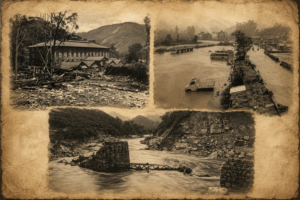
• The 1924 Deluge: In July 1924, a catastrophic monsoon dump caused massive landslides that completely destroyed the railway lines, township infrastructure, and numerous estate lines. Finlays systematically rebuilt the entire infrastructure within months, substituting vehicular roads for the lost rail tracks.
The Corporate Era: Tata Tea, Tata Tetley, and Woodbriar
Following India’s independence, British sterling companies gradually divested their assets. In 1964, a historic joint venture was forged between James Finlay & Co. and the Indian industrial house, Tata, forming the Tata-Finlay partnership.
• Tata Tea Limited (1983): Tata completely acquired Finlay’s remaining stakes, establishing Tata Tea Limited. Tata brought advanced agro-scientific research, instant-tea processing facilities, and clonal nursery techniques to Munnar, making it the epicenter of corporate tea production in India.
• Tata Tetley & Tata Global Beverages: The acquisition of the iconic British brand Tetley in 2000 expanded Munnar’s supply chain into a global blending and packaging network, eventually transitioning into what is known today as Tata Consumer Products.
• The Woodbriar Group Acquisition: As part of corporate restructuring and shifting focus toward branded retail products over raw estate cultivation, Tata Tea systematically sold off specific premium outlier estates. The Woodbriar Group, a prominent South Indian plantation conglomerate, acquired major legacy tracts in the region, continuing orthodox and CTC tea manufacturing through highly modernized processing factories.
The Modern Evolution: The Birth of KDHP
In 2005, a unique experiment in corporate restructuring took place in Munnar. Tata Tea divested its direct agricultural operations over most of the Munnar plateau, transferring the land and manufacturing units to a newly formed entity: the Kanan Devan Hills Plantations Company Private Limited (KDHP).
KDHP was structured under a unique participatory management model where the frontline workers—the estate pluckers, factory hands, and field supervisors—became the primary shareholders, holding nearly 68% of the company’s equity. Today, managing over 24,000 hectares across 7 distinct plantation departments, KDHP stands as a major model of employee-led agro-industrial operations, sustaining the multi-generational social fabric of the High Ranges.
Joe – Mistletoe Homestay & Art Gallery