Every week, I sit down with travelers from Berlin, London, or Mumbai who have come up the winding hairpin bends to visit Munnar. They want to photograph the clean, emerald geometric lines of the tea estates or look for the Nilgiri Tahr against the massive rock cliffs of Rajamala inside Eravikulam National Park. To them, it looks like a managed paradise.
But as a tourism professional who has spent half a century living alongside these villages, I have to constantly check my own industry. Building a business out of guiding people through a landscape means you see exactly how the gears turn. You watch how aggressively modern, unmindful hospitality sweeps through these hills, leveling forests to put up concrete viewing platforms, and you start to feel a deep, unsettling prick of conscience.
The longer I run my own travel operations, the more I realize that the tourism industry is prone to selling a highly sanitized version of nature—one that treats the mountains like a static backdrop for selfies. But when you step past the plantation boundaries and into the steep, vertical terrains of the Devikulam and Udumbanchola taluks, you cross a threshold into an ancient, living reality.
According to the official data from the Kerala Government’s Integrated Tribal Development Programme (ITDP), Idukki holds a massive indigenous social fabric: over 50,000 tribal residents belonging to distinct communities. Among them, the Muthuvan, the Mannan, and the Urali are the true historical architects of these high ranges.
The fact that modern development and the commercial machinery of tourism have largely failed to break into their core settlements is perhaps a great blessing in disguise. It has protected a profound way of life from being liquidated. While the modern world is scrambling to invent theories on sustainability and environmental ethics, our tribal neighbors have spent generations quietly practicing a philosophy that we are still trying to understand.
The Sovereign Cast: Three Distinct Lineages
When I track the social fabric of these mountains, I see that the tribal groups cannot be lumped into a single category. Each community has developed its own specific ecological niche, its own political structure, and its own vocabulary for reading the earth.
1. The Muthuvans: The Keepers of the Shola — The history of the Muthuvan tribe is deeply bound to the high-altitude Shola-grassland ecotone that defines Eravikulam National Park. Local lore tells of how their ancestors migrated across the Western Ghats centuries ago, carrying their deities on their backs (Muthuku meaning “back”). The Muthuvans live in forest settlements known as Kudis. Their landscape literacy is staggering. They don’t just walk the forest; they read it like a book. They know exactly which roots anchor the fragile topsoil when a monsoon cloud bursts, and they know the precise behavioral cues of a wild herd moving through the thick undergrowth long before an animal ever steps into view. The Munnar Wildlife Department has recognized this, utilizing Muthuvan trackers through Eco-Development Committees (EDCs) as the primary frontline force to monitor the Nilgiri Tahr and prevent forest fires.
2. The Mannans: The Lineage of the King — Lower down the slopes, the Mannan community holds a distinct socio-political structure. They are one of the exceptionally rare tribal groups in the entire country that still maintain an active, traditionally recognized monarchy. Headquartered at Kovilmala, the Raja Mannan is democratically chosen by the elders to govern community laws and preserve cultural values. The name Mannan merges Manna (earth) and Manushyan (human)—literally, “the humans of the soil.” Historically, they survived through shifting cultivation and foraging, but their customary laws strictly forbid the over-extraction of the land. Their internal governance structures stand as an ancient reminder that leadership can be defined by how well you protect a resource, not how fast you exploit it.
3. The Uralis: The Tree-Dwelling Architects — The Urali tribe developed a completely different, brilliant spatial strategy to handle the wild megafauna of the southern valley circuits near the Periyar catchment. Living directly alongside major elephant migratory paths, the Uralis didn’t try to build stone walls or clear-cut the trees to make themselves safe. Instead, they engineered Anamadams—highly durable treehouses constructed out of native bamboo and wild reeds, suspended high up in the forest canopy. They left the forest floor completely open for the elephant herds to pass underneath them unhindered. They didn’t disrupt the path; they simply adjusted their architecture to live above it. It is a stunning, literal example of structural coexistence that modern infrastructure completely ignores.
The Rhythms of the Ridgetops: Agriculture, Millets, and Minimalist Survival
When you look closely at the agricultural patches carved into the steep slopes of Idukki’s tribal hamlets, you don’t see the uniform, chemical-dependent monoculture of modern farming. Instead, you see a masterclass in dynamic, survival-driven cultivation that has sustained these communities for centuries.
Historically, the Muthuvans and Mannans practiced Punakkrishi (shifting slash-and-burn cultivation) on the rugged hill gradients. This wasn’t an act of forest destruction, but a highly regulated system of rotational land use. They would clear a small patch of wild brush, cultivate it for a season or two, and then completely abandon it for a decade or more to let the natural forest canopy regenerate its topsoil.
At the absolute center of this agriculture are traditional mountain millets. Long before the modern fitness industry branded millets as a superfood, these grains were the literal lifeblood of the High Ranges. The tribal farmers cultivate ancient varieties of Ragi (Finger Millet), Thina (Foxtail Millet), and Chama (Little Millet). These are not fragile crops. They are rugged, highly resilient grains that thrive on minimal water, tolerate volatile high-altitude weather, and require zero chemical fertilizers. The seeds are often sown using a method called broad broadcasting—scattering mixed seeds across the sloped earth so that millets, pulses, and wild tubers grow interlocked, ensuring that if one crop fails due to unseasonal monsoon rain, another will survive.
Minimalist Wants: The Freedom of Enough
As someone working in an industry that constantly pushes people to consume more, travel further, and buy luxury, sitting with the elders in a Kudi always delivers a sharp, internal wake-up call. Their entire lifestyle is an unvarnished lesson in structural minimalism.
Their sense of security isn’t derived from accumulating material goods, but from maintaining an absolute freedom from unnecessary wants. A traditional tribal household requires very little to be completely self-sufficient. Their shelters are built using structural bamboo, mud paste, and wild thatch harvested directly from the surrounding grasslands.
There is no desire to hoard resources. When they enter the forest to forage for wild cardamom, lemongrass, or black pepper, they operate under a strict, unwritten code of self-restraint. They leave the roots intact. They harvest only what is mature. They understand a fundamental truth that our modern economic models completely ignore: the moment you take more than you need from the land, you aren’t creating wealth—you are creating a debt that the mountain will eventually collect. This minimalism isn’t a sign of poverty; it is a conscious lifestyle choice. By keeping their physical wants small, they retain an unmatched independence. They aren’t bound to the volatile anxieties of modern market inflation, supply chains, or the frantic race for material status. They live lightly on the earth, demonstrating that true wealth is measured by how little you actually need to be content.
The Cultural Heritage: Songs for the Soil and Sholas
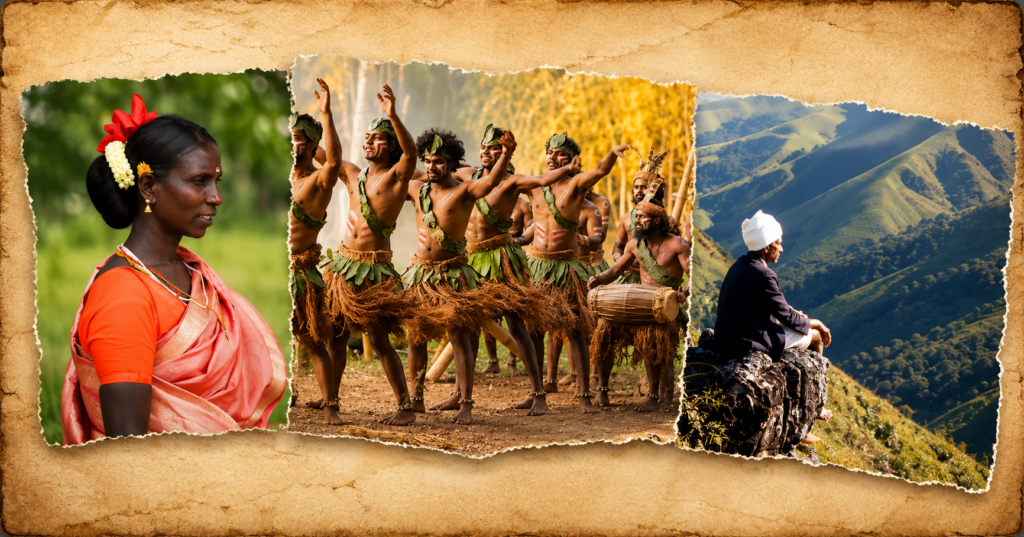
The cultural heritage of Idukki’s tribes isn’t preserved in museums or written textbooks; it is a living, breathing oral archive passed down through song, ritual dance, and specific community structures.
• The Koothu and Chathattam: The Mannan community possesses a spectacular treasury of ritual art. Their Mannan Koothu is a traditional performance art that blends music, rhythm, and satirical storytelling to pass down historical lineages, lessons on wildlife behavior, and ancestral migrations. Similarly, the Chathattam—a ritual dance performed during monumental lifecycle events—uses heavy, rhythmic footwork and ancient percussion to anchor the community’s connection to the spirits of the mountain ridges.
• The Sāthuvāttu: Among the Muthuvans, music is a direct tool for landscape literacy. Their traditional songs, called Sāthuvāttu, are musical maps. The lyrics describe the exact physical markers of the forest—which ridge paths are safe during a landslip, where the perennial water springs are hidden under the Shola roots, and how to read the call of a barking deer to know if a leopard is hunting nearby.
• The Sathram (Bachelors’ Dormitory): The social structure itself is designed to preserve this knowledge. Traditional Muthuvan settlements feature a separate communal house known as the Sathram or Chavadi. Here, the youth of the village live together under the guidance of a community elder. It functions as an informal, high-altitude academy. Every night, away from the eyes of outsiders, the younger generation sits around an open wood fire, learning the tribal laws, memorizing the musical maps, and absorbing the ethical boundaries of forest conservation.
Seeking the Social Fabric
As an entrepreneur navigating the shifting landscape of modern travel, unearthing these hidden values changes how I think about development. Modern society travels to these hills looking for an escape, yet we bring our unmindful, high-consumption habits right along with us. We fill our itineraries with commercial viewpoints, but we remain completely blind to the profound social fabric operating right on the edge of our vision.
The agricultural systems, the absolute minimalism, and the deep oral heritage of these tribes aren’t primitive relics of the past. They are clear, alternate blueprints for the future. They prove that it is entirely possible to live a deeply fulfilled, culturally rich human existence without fracturing the natural world. As I guide travelers through these mist-laden valleys, my goal is no longer just to show them a beautiful view, but to help them listen to the quiet, ancient wisdom of the people who have always known how to call this mountain home.
Joe – Mistletoe Homestay & Art Gallery